

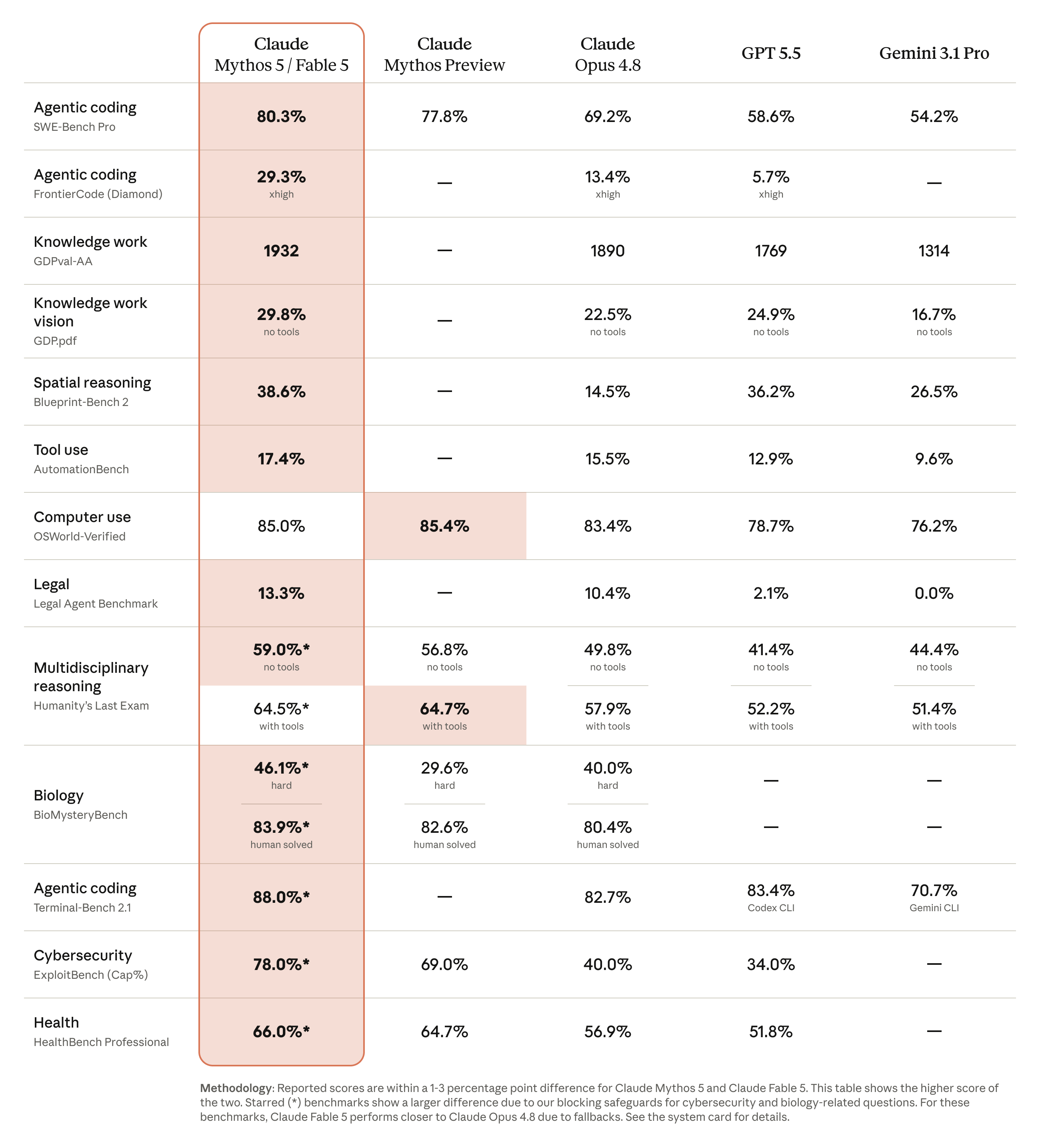
Claude Fable 5 is Anthropic’s fifth-generation flagship model and the company’s first “Mythos-level” system released for general use. It is designed for the hardest knowledge work and the most ambitious software engineering tasks, including projects that can stretch across hours or days with minimal human supervision. Anthropic positions it as state-of-the-art in coding, reasoning, long-context agentic work, vision, and computer use.
Fable 5 shares the same underlying model as Claude Mythos 5, but with a critical difference. Mythos 5 is kept behind a trusted-access wall because its full capabilities in offensive cybersecurity and advanced biology research could be dangerous if misused. Fable 5 wraps those same capabilities in extra safety classifiers that automatically block or fall back to Opus 4.8 on high-risk queries. That trade-off lets more users access frontier intelligence while Anthropic keeps a tighter grip on the riskiest outputs.
What the research says #
Anthropic’s system card and redeployment blog provide the most detailed public look at the model so far. The evidence points to a few clear conclusions:
- It is the most capable model Anthropic has trained. On SWE-bench Verified, Mythos 5 scored 95.5% and Fable 5 scored 95%. On the harder SWE-bench Pro, Mythos 5 hit 80.3% and Fable 5 hit 80%. Both are well ahead of Opus 4.8 (88.6% Verified, 69.2% Pro) and GPT-5.5 (80.6% Verified, 58.6% Pro).
- It performs best inside an agent harness. Fable 5 is not just a chat model. Run through Claude Code or Claude Managed Agents, it can plan across stages, delegate to sub-agents, and check its own work. On FrontierSWE, a benchmark of 17 ultra-long-horizon engineering problems with 20 hours per task, Fable 5 ranked first on mean performance.
- It can read visual context. Fable 5 understands diagrams, charts, and tables embedded in files and PDFs. That makes it useful for finance, legal, analytics, and architecture workflows, and lets it compare generated code or designs against original visual goals.
- Its safeguards are stronger but imperfect. Anthropic doubled the safety team before launch and deployed classifiers that detect potentially harmful cybersecurity or biology queries. Flagged requests fall back to Opus 4.8 without charging Fable prices. After a June 2025 report showed a bypass, Anthropic retrained a classifier that now blocks the described technique in over 99% of cases.
- Access has been turbulent. The US government briefly applied export controls on June 12, forcing Anthropic to suspend access worldwide. The controls were lifted by June 30, and global access was restored on July 1.
Where software engineers should use it #
Fable 5 is not a replacement for quick autocomplete or casual Q&A. Its sweet spot is work that rewards sustained reasoning:
- Large-scale migrations across frameworks, languages, or cloud platforms.
- Complex multi-file implementations where the model must reason about architecture, not just syntax.
- Multi-day autonomous coding sessions that include writing tests, running them, and iterating.
- Design-to-code workflows where vision helps verify that output matches mockups or specifications.
- Deep research and analysis that produces a structured deliverable rather than a one-paragraph answer.
How to implement it well #
The best engineering pattern is agentic, not conversational. A practical setup looks like this:
- Give it a sandbox with tools. The model needs a repo, a test runner, a linter, and ideally a way to inspect build or CI output.
- State the goal, not every step. Fable 5’s value is in planning and executing the intermediate stages itself.
- Let it self-check. Ask it to write tests, run them, and use vision or static analysis to validate outputs.
- Require human review gates. Commits, merges, and deployments should still need a person.
- Respect the safety boundaries. If your work touches offensive security, malware, or dual-use biology, expect fallback to Opus 4.8. For legitimate defensive cyber work, Anthropic offers a Cyber Verification Program.
Two ways to think about it #
For someone new to AI assistants, Fable 5 is like a research partner that can stay focused on a big project for days. You describe what you want built or analysed, and it keeps track of the plan, does the work, checks it, and hands back a draft. You still review everything before it ships, but the tedious middle part is handled.
For a working developer, Fable 5 is a reasoning-heavy coding agent. You would use it through Claude Code or the API with claude-fable-5, set broad objectives, and treat its output like a senior colleague’s pull request: impressive, but still needing review, tests, and production scrutiny.
Pricing and availability #
Fable 5 is available to Pro, Max, Team, and Enterprise users on the Claude Platform, Claude.ai, Claude Code, and Claude Cowork. It is also accessible through AWS, Google Cloud, and Microsoft Foundry. API pricing is $10 per million input tokens and $50 per million output tokens, with a 90% discount on cached input tokens. US-only inference costs 1.1x. Using Fable requires accepting 30-day data retention for safety monitoring.
Would you hand a long-running engineering project to an AI agent with review checkpoints, or do you prefer tighter supervision? Share your take in the comments.